I will publish articles I have written on my vacation in Cadenet in south France in the last two weeks of May and the first two weeks in June.. Of course I (and occasionally Bram and Eva) have shot photo’s on location. Probably some photo's will not be as sharp or clear as I wished, but I think they captured the feeling of the moment. The second article puts a spot on the "Gritstone, the yellow basic model of the DW-9100 Riseman.

Since 2002, the first holiday with Bram, and also the first holiday after I started collecting Gs, I take a small assortment of G-Shocks with me on a holiday.

In 2002 we went to a camping near Champignelles, a small village in the north of Bourgogne. It was a small farm camping, the farmer bred horses.
During day time it was nice warm, around 30°C. At night there was no light at all and it became very, very cold. We slept in a tent and in the morning most people on the camping who were sleeping in tents talked about this cold at night.
This brought me on an idea. My DW-9100 Riseman had a small recorder function on board. Every 15 minutes it samples the current altitude and temperature until the 50 data sets are full (12.25 hours, as the start time holds 1st position).

When the topic about the cold nights were discussed again, I agreed. "The temperature even dropped to 6.2°C at 6:15!". You must have seen the faces when I showed my recorded data. Since then I always have a Riseman with me when camping.

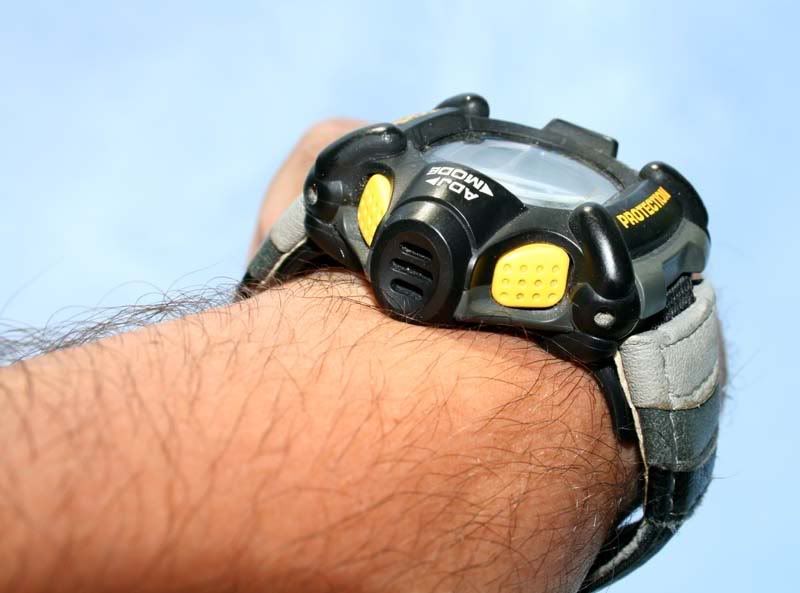
The watch I used then was my first Riseman. It was one of the basic versions, in Germany called "Skytramp". It's the version with the red lettering. The model featured today is the version with yellow lettering and accents, the "Gridstone". I actually wanted to feature the Skytramp, but I simply couldn't find when I was packing my vacation stuff and I didn't have much time to find it.

I got this Riseman from a good friend in Australia. He found the yellow accents a bit too much outstanding. He later bought a Men In Black (MIB) version, which is mainly black with a little white lettering. My Gridstone itself is in great condition, but fortunately the back of the band show much wear. I sometimes think about to buy new straps for it, but it still feels very comfortable.

The case of the Riseman is pretty unique shaped. Someone once wrote that it looks a bit like the parachute packs of Japanese parachutists. On the left side you'll find the sensors. The Riseman has a thermo sensor and a barometric sensor. On the back you will find Icarus in flight engraved.

On a good watch with a barometric function, you will always find a thermometer function. Barometric sensors are very accurate, but they show temperature drift. This means that the sensor output does not only change with air pressure, but also react on temperature changes. If the temperature is known, temperature drift can be eliminated.

The Riseman has an Altimeter function. The altimeter function is actually a barometric function. If you ascent, the air pressure decreases and vice versa. The barometric changes are very small, but with a very accurate temperature compensated barometric sensor, the altitude changes can be calculated. The accuracy of the Riseman is +/- 5m. You can debate if a higher accuracy is needed, but someone who seriously uses an altimeter, does climb a lot more than a few meters. The higher you ascent, the higher the relative accuracy.

Note that you always have to set your altimeter to the correct altitude before use. As the air pressure changes with weather, the altimeter will give different readings after weather changes. If the current altitude is not known, you can set a relative altitude, so you always know how much you ascent or descent. It might be clear now that the altimeter is more accurate at nice sunny weather, than in rough weather. If you get into a thunderstorm, the altimeter could go wrong for over 100m or more. There you go with your temperature compensated 5m accuracy.

Sensor watches (and electronic altimeters) consume more energy than "just" a digital watch. I use also Cateye altimeters. I have them build in some of my bike computers, and also have a specialized altimeter, that I often use on vacation in the car (see also picture in #18, "Jammin' dans le Soleil"). It's an AT-110. It can be used for hiking, skiing and paragliding (Fly mode). I need to change batteries before we go on vacation, because else they are empty while using, though it carries the big CR2032 battery. In the most accurate mode (Fly mode) this altimeter constantly samples the air pressure, and even gives alarms when the rise or fall speed is over 2 meters per second. In this mode my altimeter will only work for several days.

The Riseman is made for hiking. In altimeter mode, the first minutes the display is updated every minute, but soon it goes over to one refreshment in 15 minutes. I actually use the recorder function too when traveling to a country with mountains. I happen to live in a country where most parts are as flat as a pancake.

The Riseman came in Europe in three versions. The red version only had red lettering, the yellow version (as featured here) has also yellow buttons and the blue version has blue lettering and a blue strap. The strap is actually also unique. The upper part is made of parachute fabric. This might indicate you can use the watch for parachuting, but with the 15 minute sample frequency, I won’t recommend that.
 The basic Riseman uses the 1664 module. This module has the ability to switch between meters and feet and also between °C and °F. Special models, like those of the "Men In ..." series, were made for the Japanese home market. These have the 1663 module, that only can display meters and °C. Actually I have no idea why two different modules are used (this is actually also the case with the DW-6700 Skyforce, the predecessor of the Riseman).

Since this watch is packed with features, I think we must be glad there is also a stopwatch function on board. I have a PRG-50 Protrek, which does not even have this function. It lacks the usual countdown timer function.

I think the Riseman was a great watch, ahead of it's time when it was released (and what to think of the DW-6700!). Nowadays the features are probably passed by the latest atomic ProTrek models and the also very popular Suunto and Nike AB(C) watches. I think it's still an great looking watch. I frequenty wear three models on rotation. One of the nicest model I own is the red translucent Terje Haakonsen Riseman.

Lately (as also featured in the Japanese magazine "G-Shock, The Complete Reader", March 2008) Casio announcced that the Riseman will evolve into a next generation Master of G. In August Casio will release the first 6 band Atomic G-Shock, the GW-9200 Riseman.
 Casio claimes this watch is the most accurate they have ever made. New is that it also can use the public transmitter in China to adjust for atomic time.

The design of the GW-9200 follows that of the new Master of G models, the G-9000 Mudman and G-9100 Gulfman, but it also features the assymetry of the sensor, like on the good old one.


 In 2007 Casio started releasing special series for the 25th anniversary of G-Shock. In May the Dawn Black series saw daylight, in August it was the Rising White series. In this last series there was a DW-5000 re-issue and even a DW-5700C re-issue.


 The module used in this and the DW-5725B model, the 1545, is the same module that is used for the common DW-5600E.


 This is the last of a series of articles I have written during my vacation in Cadenet in south France. I (and occasionally Bram and Eva) have shot photo’s on location. Probably some photo's will not be as sharp or clear as I wished, but I think they captured the feeling of the moment. I hope you enjoyed reading and viewing these articles.
 Our dinner on the way back, in Luxembourg. I could use a beer. I had driven over 500km in one piece. After dinner Eva took over for the last 350 - 400 km.


