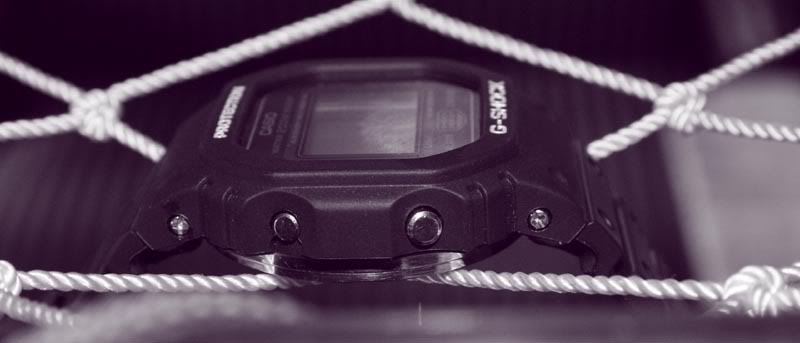
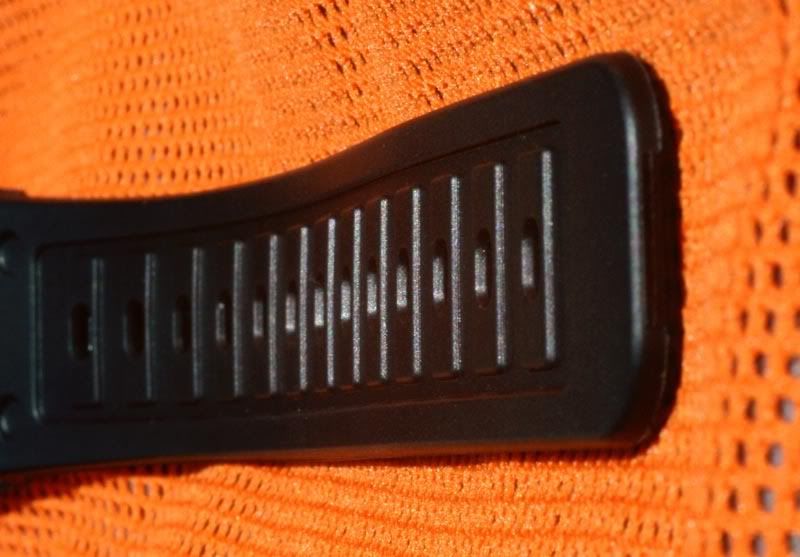
Already over 26 years ago, on April 1983, the first G-Shock was launched, the DW-5000C "Gravity Shock", in two versions, -1A with red lettering and -1B with gold lettering.
A funny detail is the text LITHIUM on the display. Nowadays the most common button cell batteries, like the CR-1616, CR-2016, CR-2025 and CR-2032 are lithium batteries.
 This model evolved pretty much unchanged via the DW-5200C to the DW-5600C. Aside from this line the WW-5100C (5000 produced) and WW-5300C (15000 produced) were released as Casio experimented with extreme low temperature resist LCD's (WW = Waterresist Wide Temperature resist).
 The WW line wasn't needed to be continued. Further research of liquid crystals lead to low temperature resists displays for all G-Shocks (-30ºC to 50ºC).
A round sister model was introduced as the DW-5400C, which evolved into the DW-5700C and later 5700 models.
 Also interesting was a basic square where the buttons were totally covered by the bezel. The DW-5500C G-ShockII "Mudman" was very unique. For a long time it looked like it would be a dead-end development, but since June 2006 the 5500 model is revived in both a G-5500 as a GW-5500 model.
 The DW-5600C was very popular and produced from June 1987 to June 1996. While its predecessors were based on the 240 module, the DW-5600C got the improved 691 and 901 module. So you might consider it the 2nd generation basic G-Shock. With a price of only ¥9800 it was very affordable.
 For it's time G-Shocks were pretty big, especially for the domestic market. In March 1988 a smaller version of the DW-5600C was launched, the DW-500C-1 with the 540 module (no light bulb). This model got nicknamed Baby-G. In 1993 a yellow DW-500C-9B was released. With a retail price tag of only ¥7900, this is probably the most affordable G-Shock made. Since 1997 Baby-G is an official spin off Casio sub-brand, mainly popular by women and girls.
 In 1994 Casio launched the DW-6600, in answer to Timex's "Indiglo", the first G-Shock with an Electro-Luminescent backlight. In 1995 the DW-6900 was added to the G-Shock line. In June 1996 the DW-5600E was launched. The 1545 module featured also the EL backlight. These three models are today still the most popular models for limited edition releases.
 Though from the outside this 3rd Generation basic G-Shock looked pretty much like it's ancestors, the guts pretty much changed. Until the DW-5600C Casio used steel cases with a screwback. All those screwback models also had a serial number.
The DW-5600E has a resin case. This improved the shock impact resistance and also reduced the weight of the watch very much.
 A resin case and screwback won't go together. The thread would be stripped too easily. A stainless steel backplate with four screws replaced the screwback. Though many regret this change, it does not affect the water resistance. It might even improve it if not proper installed.
 The four-screw backplate is pushed on a rubber gasket when attached. If the watch becomes under water pressure, the back will be pushed harder onto the case (where still is an 1 bar air pressure environment). This type backplate makes it easier to open the watch for battery changes. Also a screwback easily get scratched by opening the case, even worse things happen if the opener tool slips.
 Still the story of the basic G-Shock doesn't end. In September 2002 Casio released the Tough Solar G-5600 (4th generation basic G-Shock). Battery changes were not needed anymore and a full charged watch provides energy for many months. Another improvement, the Countdown Timer on this model can be set to 99 hours.
 This model became equipped with the infamous CLT1616 battery. Models bought around 2003 could get what was later called "The Recovery Blues". It appeared Casio got a batch of these batteries from Panasonic. Quite a high percentage of these batteries suddenly went into recovery mode after approximately 1 year loyal service, even if the battery if fully charged.
A few years ago someone got a mail from Casio (I unfortunately can't find that post anymore) confirming they got a faulty batch, but Panasonic now delivers an improved CTL1616 version, even with a bigger capacity.
 The recovery blues was mainly affecting the GW-300 and some G-5600 models. Also a PRG-80 was reported once with the same symptoms.
If you have a watch with the recovery blues, replace the battery (preferred by a Casio service center). I have a 75% faulty percentage on my GW-300's (the 25% has another module), but after a €14.- battery change and water resistance test they work all three flawless.
 In March 2005 a logic successor was launched, the 5th generation basic G-Shock the GW-5600. To good to be true. A waveceptor function, Tough Solar, World Time instead of Dual Time.
At the time I heard about the release, I wanted one (though I was not such a big fan actually of the "basic squares").
 It was not only released in Japan, you could also find it, for even better prices in the US. Waiting was for an European release. Well, there lies the bummer. Probably because the US transmitter uses the same frequency of one of the two JP transmitters, it was easy to make a watch that could receive both the JP as the US signal, but somehow the Mainflingen signal (near Frankfurt, Germany, the Rugby transmitter wasn't used around that time) wasn't included. Long have I waited for that European version.
 Another function was changed. The GW-5600 got a 60 minutes countdown timer. That’s even worse then the 12 hour(!) countdown timer on the 240 module of the DW-5000C...
 Finally in February 2008 (after publishing photo's months earlier) Casio came with a massive update. The 6th generation basic G-Shock (or as Casio calls it Type VI). The GW-M5600 does receive 5 atomic time transmitters, which were all public transmitters around that time. In the meantime a transmitter in China is added.
 I was pretty lucky. Keith from Tiktox mailed me he was getting a limited supply of this model. I noticed if you are a good customer, sometimes sellers inform you about novelties or special deals.
The display lay-out of the watch does not differ much from it's predecessors. The space around the display looks pretty different. I think it's about the most and busiest lettering on a G-Shock. The lower part has even 4 lines of text. It looks like reading a book! I think if I designed the watch, I could have done it with less words.
 The functions on the watch are what you can expect from a basic (Waveceptor) watch. Worldtime, a 1000 hours Stopwatch, a 60 minutes Countdown timer and 5 alarms with hourly chime.
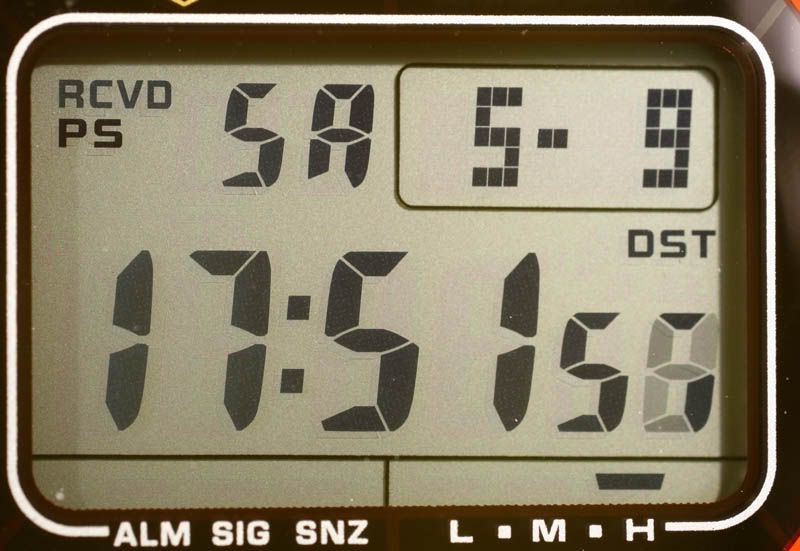
 This model has, like all newer Tough Solar models a Power Save (PS) function. This function goes to sleep mode the LCD when the watch isn't used for some time during daytime. All Tough Solar models have a movement sensor for the Full Auto-EL function. In Power Save mode, the watch can work in the background for about 11 á 12 months.
 Actually Casio announced another update of the basic G-Shock. Soon (May 31) the GW-5000 will be released. I think we can consider this model the 7th generation of the basic G-Shock.
The number 5000 reveals it all. The steel case with screwback returns. The 6th atomic time transmitter is added and good news, the 24-hour Countdown Timer returns. Also the lettering is pretty decent.
 I think there will be not much to improve. Well, maybe the price tag is a little steep, but you wanted that steel case with screwback. For a little less than $400.- (¥39000) you'll have the perfect basic G-Shock.