
Finally the winter is out of our country. Last Sunday it was pretty nice weather for showing off at the beach. Eva did a training walk for the Coastal Marathon (for walkers), so I took my latest MR-G to the beach. Today's featured G: MRG-100-7.

While most of us picture a metal watch in our mind when hearing the word MR-G, the series started in 1996 actually with models with a resin bezel. Though the case was titanium, the price of these MRG-1 models was with 24000 yen not yet very expensive.

The MRG-1 was designed to be small, matching with a suit and would slip easy under a long sleeve. The MR-G logo was't featured on the front, but engraved big on the screwback. .

In November 1996 the first MR-G models was released in the way we know it. Full metal, stylish and quite expensive
*.

I was at the house of a friend when I just started collecting G-Shock's somewhere in 2001. He said he liked my G-Shock's, but if he would buy one, he would go for a MR-G. It was the first time I heard about MR-G actually.

Of course I was tickled by the name and started looking for them. Where you could become a G-Shock in good shape around DM40.- (now €20.-) in Germany, a MR-G would start at around DM140.-. Compared to other G-Shock, very expensive (note that when the Euro was introduced in 2002, prices for G-Shocks on eBay nearly doubled).

In August 2002 I got my first MR-G, It was a MRG-1000 Tactician, that in Germany was called "Oceal Liner". I should do an 50Gs on that one too, but now lets focus on this MRG-100.

The MRG-100 was the cheapest of the range metal MR-G models at the end of 2006. I think quite a few were being made, since the serial number on this one starts with 74.... This means it was produced in April 1997. The retail price in Japan was 40000 yen. In that days that would have been over 600 Dutch Guilders/DM 558.-/$353.- (€279.-), which was a lot of money in those days (source:
Historic Lookup)

Casio tells about this model, that 13 years after the birth of G-Shock, an adult G-Shock is designed. The whole structure breathes the atmosphere of protection. The sphered crystal and the solid watchband gives the feel of Luxury. The back protector makes it comfortable to wear.

While most MR-G models were available worldwide, the MRG-100 wasn't. Or yet it was, under another model number. In the catalog
MR-G 1999 it was listed as the DW-8900.

Actually when I bought this watch from a friend October 2008 (it was a real good bargain), I thought I was buying a DW-8900. I was really happily surprised I actually got the MRG-100 in the mail.

The MRG-100, is like all other MR-G models that I know, relative small and pretty heavy. The width of the case is 41 mm, while the case of the relaive small G-100 is already 46mm.

One reason why the MR-G is pretty heavy is the use of solid links on the bracelet. Also the case is very heavy, specially if you are used to the very light resin G-Shock's. Actually I like the feeling of weight on my wrist when I wear a MR-G.

On the back of the watch there is a rubber ring. This rubber ring is clamped between the case and the screwback. It is not only a back impact protector, but it makes the watch also comfortable to wear and keeps the case good in place on the arm.

The bracelet and case are made of brushed steel. Only the ring around the display is made of shiny metal, giving the watch a nice accent. The 4 screws that hold that ring in place, give the watch a very tough look, like it is saying "I'm indestructible".

The face plate (the part inside the case that blocks unused parts of the LCD display), is made of white plastic, covered with steel. On the edges the white plastic shines through, while most of the face plate is metal.

While most lettering is etched or printed on the metal, the MR-G logo stands out. The crystal is sphered, but it doesn't show as much reflection as the Raysman, Gaussman or Riseman.

The white "bridge" in the display, shows if a function is turned on or off. When a function is turned on, a small line appears on the display.

ALM and SIG stand for Alarm and Signal (duh), Split shows that you are watching split time in Stopwatch mode, Auto can be turned on in the Countdown timer mode.

A bit of a flaw, in my opinion, on these MRG Models, is that the alarm sounds very soft. Probably the massive metal case is muting the sound. It's not only on the MRG-100, but I noticed this on my other MR-G models too. So if you own one and think it's a defect, nope, it isn't. Maybe it fit's in the philosophy that MR-G models do not stand out (smaller, luxurious look, but easy fit under a sleeve).

One of the nicest function on the MR-G of these period, is the EL backlight. It has a very nice shade light blue EL. It's very bright and clear.

So, are there differences between the MRG-100 the DW-8900? For the DW-8900 Casio used the -1 version. The only differences are found at the bracelet and the screwback.

According the DW-8900 that
Sedi posted on the Uhren Forum, the Bracelet shows above the case the text SHOCK RESIST and under the case G-SHOCK (respectively G-Shock and MR-G on the MRG-100). WHere the MRG-100 shows the nice big MR-G logo, the DW-8900 shows G-SHOCK.

If you ask me if the DW-8900 is a MR-G, I would be very confident to say yes. Not only it is a MRG-100-1 with other lettering, it is also shown in the 1999 MR-G catalog 1999 under the name Luminary. Retail Price of the DW-8900 was DM549.-, which was in 1996 practically the same price as in Japan.
 * A few versions were released with leather or resin strap.

 Finally the winter is out of our country. Last Sunday it was pretty nice weather for showing off at the beach. Eva did a training walk for the Coastal Marathon (for walkers), so I took my latest MR-G to the beach. Today's featured G: MRG-100-7.
 While most of us picture a metal watch in our mind when hearing the word MR-G, the series started in 1996 actually with models with a resin bezel. Though the case was titanium, the price of these MRG-1 models was with 24000 yen not yet very expensive.
 The MRG-1 was designed to be small, matching with a suit and would slip easy under a long sleeve. The MR-G logo was't featured on the front, but engraved big on the screwback. .
 In November 1996 the first MR-G models was released in the way we know it. Full metal, stylish and quite expensive*.
 I was at the house of a friend when I just started collecting G-Shock's somewhere in 2001. He said he liked my G-Shock's, but if he would buy one, he would go for a MR-G. It was the first time I heard about MR-G actually.
 Of course I was tickled by the name and started looking for them. Where you could become a G-Shock in good shape around DM40.- (now €20.-) in Germany, a MR-G would start at around DM140.-. Compared to other G-Shock, very expensive (note that when the Euro was introduced in 2002, prices for G-Shocks on eBay nearly doubled).
 In August 2002 I got my first MR-G, It was a MRG-1000 Tactician, that in Germany was called "Oceal Liner". I should do an 50Gs on that one too, but now lets focus on this MRG-100.
 The MRG-100 was the cheapest of the range metal MR-G models at the end of 2006. I think quite a few were being made, since the serial number on this one starts with 74.... This means it was produced in April 1997. The retail price in Japan was 40000 yen. In that days that would have been over 600 Dutch Guilders/DM 558.-/$353.- (€279.-), which was a lot of money in those days (source: Historic Lookup)
 Casio tells about this model, that 13 years after the birth of G-Shock, an adult G-Shock is designed. The whole structure breathes the atmosphere of protection. The sphered crystal and the solid watchband gives the feel of Luxury. The back protector makes it comfortable to wear.
 While most MR-G models were available worldwide, the MRG-100 wasn't. Or yet it was, under another model number. In the catalog MR-G 1999 it was listed as the DW-8900.
 Actually when I bought this watch from a friend October 2008 (it was a real good bargain), I thought I was buying a DW-8900. I was really happily surprised I actually got the MRG-100 in the mail.
 The MRG-100, is like all other MR-G models that I know, relative small and pretty heavy. The width of the case is 41 mm, while the case of the relaive small G-100 is already 46mm.
 One reason why the MR-G is pretty heavy is the use of solid links on the bracelet. Also the case is very heavy, specially if you are used to the very light resin G-Shock's. Actually I like the feeling of weight on my wrist when I wear a MR-G.
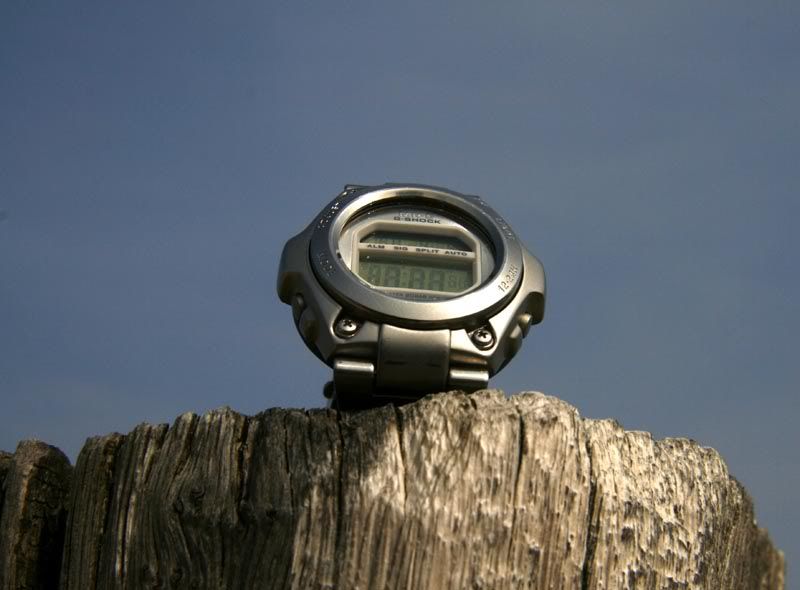 On the back of the watch there is a rubber ring. This rubber ring is clamped between the case and the screwback. It is not only a back impact protector, but it makes the watch also comfortable to wear and keeps the case good in place on the arm.
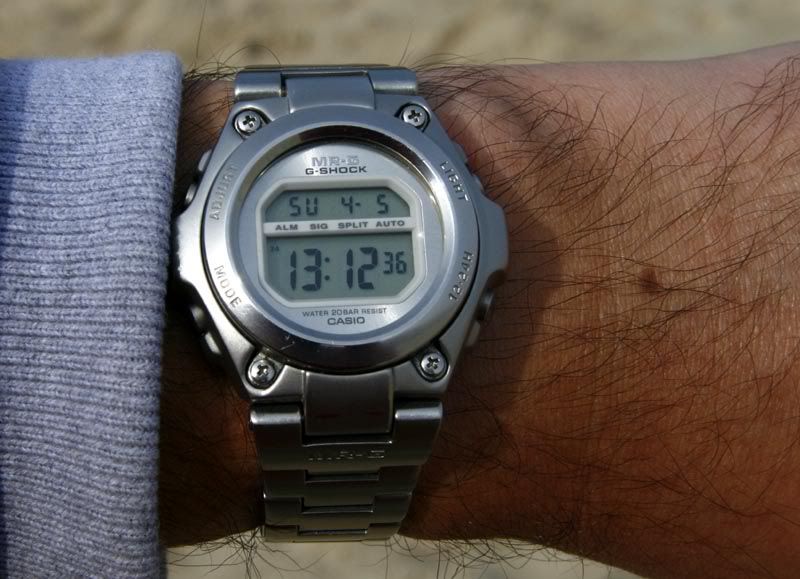
 The bracelet and case are made of brushed steel. Only the ring around the display is made of shiny metal, giving the watch a nice accent. The 4 screws that hold that ring in place, give the watch a very tough look, like it is saying "I'm indestructible".
 The face plate (the part inside the case that blocks unused parts of the LCD display), is made of white plastic, covered with steel. On the edges the white plastic shines through, while most of the face plate is metal.
 While most lettering is etched or printed on the metal, the MR-G logo stands out. The crystal is sphered, but it doesn't show as much reflection as the Raysman, Gaussman or Riseman.
 The white "bridge" in the display, shows if a function is turned on or off. When a function is turned on, a small line appears on the display.
 ALM and SIG stand for Alarm and Signal (duh), Split shows that you are watching split time in Stopwatch mode, Auto can be turned on in the Countdown timer mode.
 A bit of a flaw, in my opinion, on these MRG Models, is that the alarm sounds very soft. Probably the massive metal case is muting the sound. It's not only on the MRG-100, but I noticed this on my other MR-G models too. So if you own one and think it's a defect, nope, it isn't. Maybe it fit's in the philosophy that MR-G models do not stand out (smaller, luxurious look, but easy fit under a sleeve).
 One of the nicest function on the MR-G of these period, is the EL backlight. It has a very nice shade light blue EL. It's very bright and clear.
 So, are there differences between the MRG-100 the DW-8900? For the DW-8900 Casio used the -1 version. The only differences are found at the bracelet and the screwback.
 According the DW-8900 that Sedi posted on the Uhren Forum, the Bracelet shows above the case the text SHOCK RESIST and under the case G-SHOCK (respectively G-Shock and MR-G on the MRG-100). WHere the MRG-100 shows the nice big MR-G logo, the DW-8900 shows G-SHOCK.
 If you ask me if the DW-8900 is a MR-G, I would be very confident to say yes. Not only it is a MRG-100-1 with other lettering, it is also shown in the 1999 MR-G catalog 1999 under the name Luminary. Retail Price of the DW-8900 was DM549.-, which was in 1996 practically the same price as in Japan.
 * A few versions were released with leather or resin strap.
